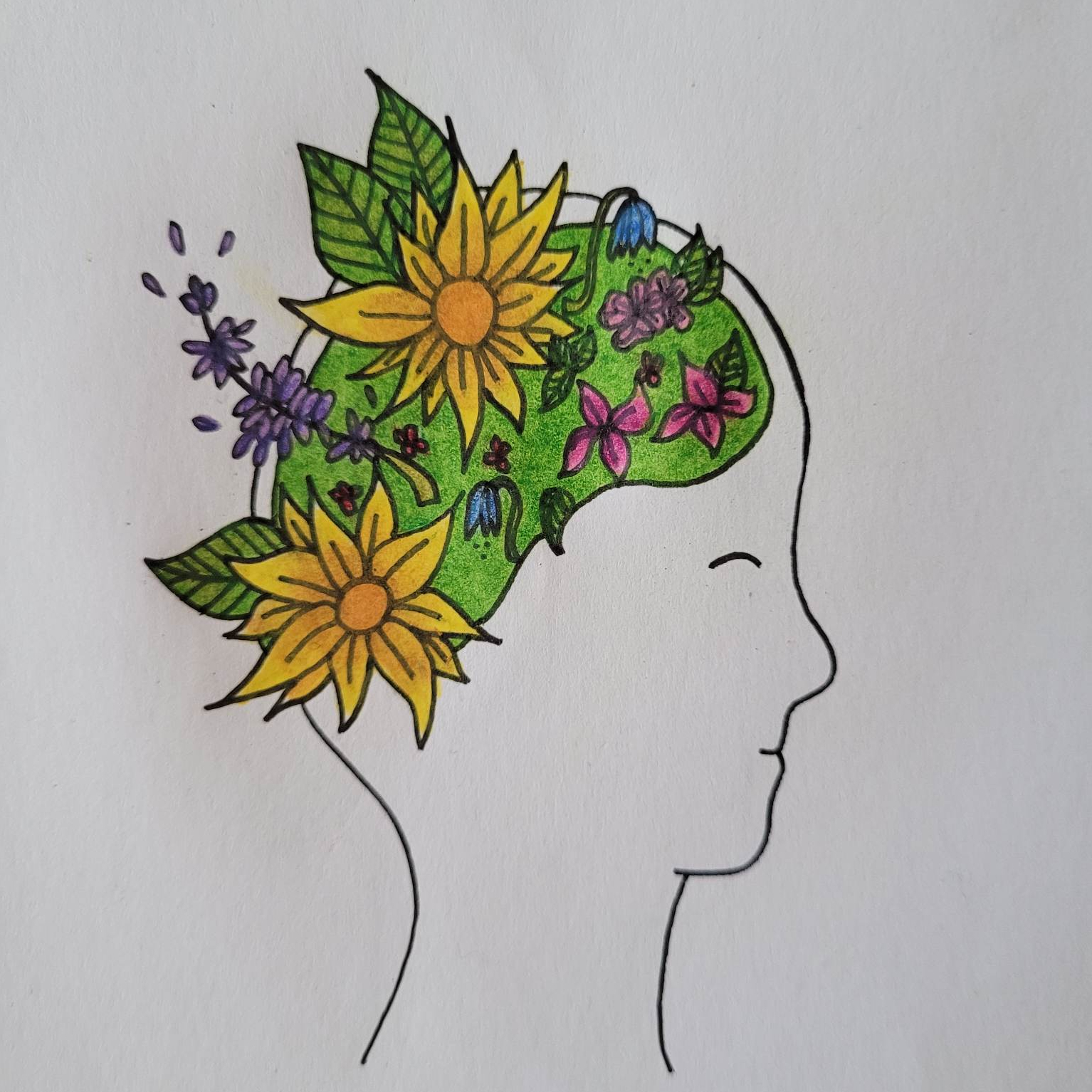
Some of you may have heard about the Autism Spectrum, but what exactly is this spectrum?

The idea of autism as a spectrum is the model that gives us an understanding of the variation between Autistic people, despite the traits we have in common. The notion of what this spectrum looks like however has changed during recent years.
The original idea was that the Autism Spectrum was a straight line that went from severely autistic in one end to a little bit autistic in the other. The positive thing about the spectrum is, as mentioned above, that it gave us a broader understanding of the diversity within autism. This has, among other things, made it easier to diagnose people who would have otherwise gone under the radar.
However, the linear idea of the spectrum has been challenged and criticized by several Autism Self-Activists and by academics. These Autism Self-Activists have pointed to their own experiences with the neurotype to argue against the use of autism levels. Some academics have also started to delve into this issue. To those who are interested in reading more about this, I can recommend the articles “From Autistic Linear Spectrum to Pie Chart Spectrum” (2022) by Claire Jack and “Autistic or with Autism” (2021) by Pia Bradshaw.
The new proposed way to view the spectrum is as a color circle. This is often referred to as the Autism Wheel. In this color wheel each color represents an autistic trait. As I mentioned in my third blog post “What is autism?” you need to have both the basic autism traits to qualify for a diagnosis. This means that you have to present challenges with social interaction and communication as well as with routine and repetition.
In addition to these basic traits, there are several other autistic traits that can be present. It’s the combination of the basic traits that indicate autism, not one trait alone. Due to this, many argue that the understanding that everyone is a little bit autistic, is incorrect. The opinion is that you can’t be in the Autism Spectrum if you’re not Autistic and you’re either Autistic, or you’re not.
The Autism Wheel illustrates the degree and presence of each trait of a person with ASD. This way each Autistic person can get a more precise and personal profile that shows their unique challenges and gifts within the neurotype.
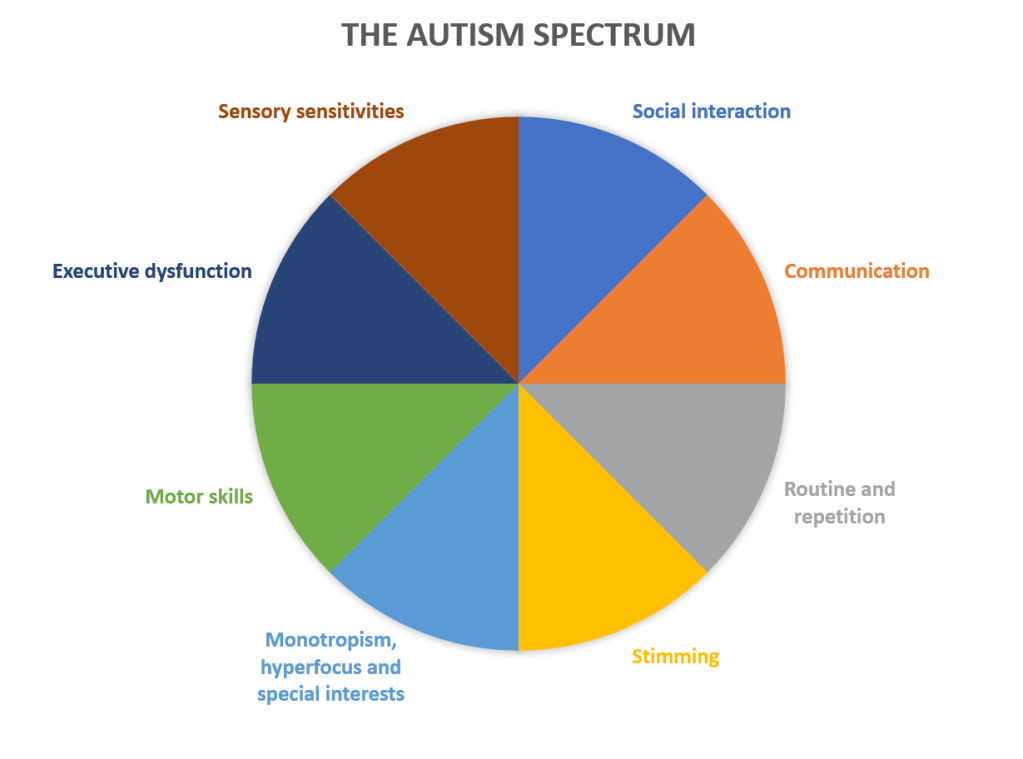
There are many autistic traits and therefore also many traits that can be included in the spectrum. Here I have chosen to include eight categories. These are the common traits of ASD divided into “social interaction”, “communication”, “routine and repetition”, “stimming” and “monotropism, hyperfocus and special interests”. In addition, I have chosen to include the traits “sensory sensitivities”, “motor skills” and “executive dysfunction”.
Those who favor the Autism Wheel point out that we shouldn’t use autism levels or functioning levels (high- and low-functioning). These degrees have been used with the understanding that a high degree of autism leads to a low functioning level and that a low degree of autism leads to a high functioning level. The linear spectrum indicates that degree of autism, functioning level and visibility in behavior are all interconnected. The Autism Wheel on the other hand, indicates otherwise.
The Autism Wheel criticizes this idea of interconnectivity as well as the notion of the existence of degrees of autism and functioning levels.
Firstly, seeing a connection between the degree of Autism and functioning level is problematic. This is because we now have more knowledge about ASD and how it also can include neutral traits and even gifts, not just challenges. The positive and neutral differences have just as much to do with the neurotype as the challenging traits. Thus, defining degree of autism as equivalent to the degree of challenges and function should no longer be considered accurate.
Furthermore, seeing a connection between the degree of autism and behavior, is also considered problematic. This is due to the new knowledge we have of masking. Masking is a defense mechanism many Autistic people use consciously or unconsciously to hide their autistic traits and needs. Therefore, seeing a link between behavior and degree of Autism isn’t really precise either, because the observed behavior isn’t always a good indicator of the actual challenges of each individual.
Behavior is an issue that leads to problems for Autistic people in different ways. For those of us who are high-masking it’s frustrating because others often do not understand what they can’t see. For those who have a clearly divergent behavior it’s challenging because of the negative stigma and the ableism they face. According to autism researcher and PhD student Pia Bradshaw, these categories (high- and low-functioning), lead to minimizing the challenges of Autistics who don’t appear outwardly different and minimizing the strengths, abilities and capacities of those who do.
Secondly, the Autism Wheel doesn’t define the degree of autism at all. This is because even if you were to include all the types of traits (positive, neutral and challenging) this is not considered accurate. That is because no matter the degree of challenges or gifts present, they are all due to the fact that a person has an autistic neurotype. You either have this neurotype, or you don’t. Therefore, it’s more precise to define the degree of challenges and strengths of each Autistic individual, than trying to define their degree of autism.
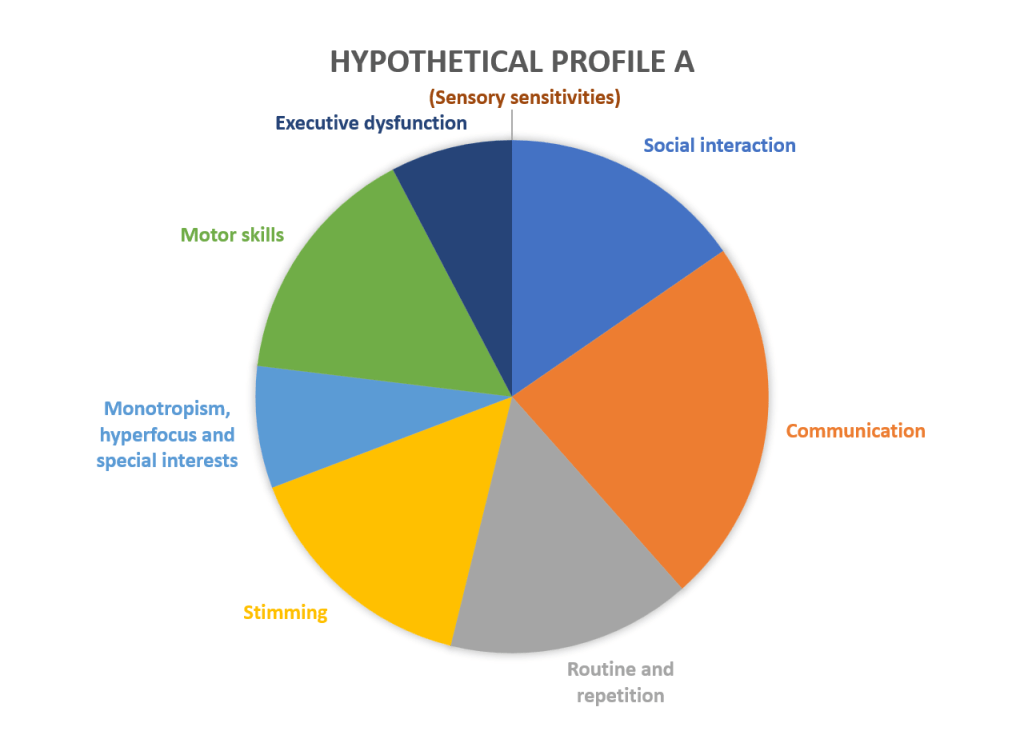
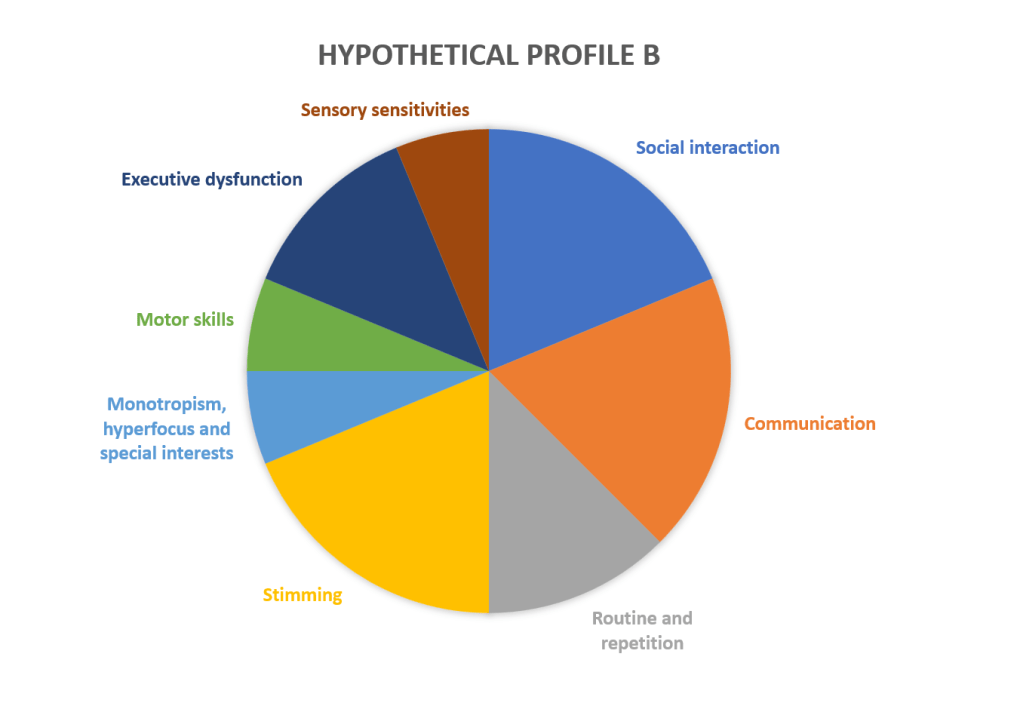
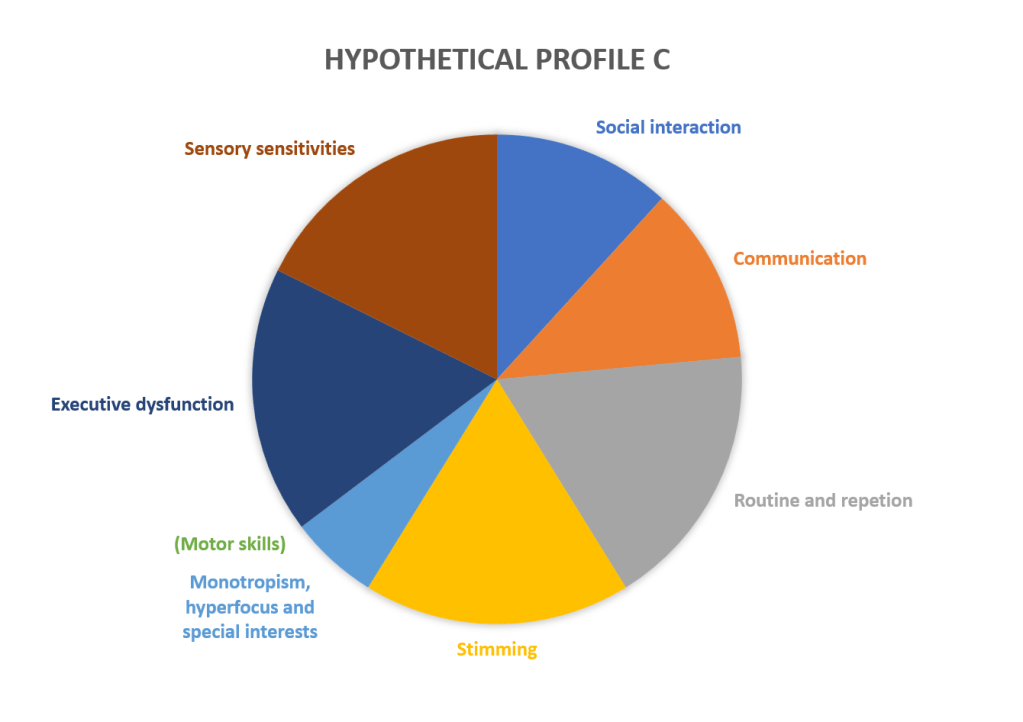
This is an example of three hypothetical Autistic individuals with unique profiles. None of the profiles are more or less autistic than the others. The bigger the area of each trait, the more each person has of said trait. Each trait can lead to both challenges and talents.
In my opinion this is an important distinction. My argument is that if the degrees of autism were to exist then all the autistic traits of each Autistic person would be of the same degree. A person with a high degree of autism would then have had a high degree of all their autistic traits and vice versa.
When I think about my own autism profile, I can see that this isn’t the case. I have a higher degree of “sensory sensitivities”, “stimming” and “monotropism, hyperfocus and special interests”, a medium degree of challenges with “social interaction”, “routine and repetition” and “executive dysfunction” and a lower degree of challenges with “communication” and “motor skills”. Is it then correct to define my autism as low? That doesn’t seem very accurate.
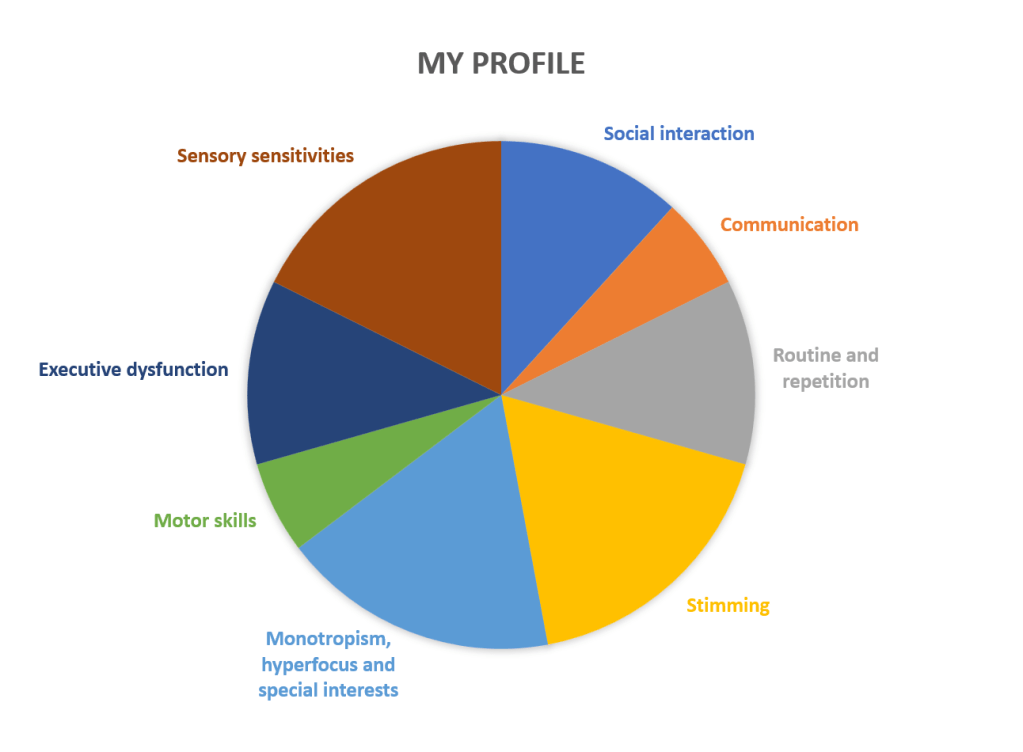
That is why many think that the Autism Wheel is a good illustration of the spectrum because it gives us an understanding that no Autistic person is more or less Autistic than another. It gives us the opportunity to understand the degree of each trait instead of the autism as a whole. Like Claire Jack (PhD) argues, this helps us to see the complexity and the unique profile of each Autistic person. I think this is positive as it gives a clearer picture of autism and Autistic people.
Thirdly, there are many who are against the use of functioning levels. There will always be some Autistic people who have greater challenges than others, but according to Pia Bradshaw, functioning levels are not static, but fluid. They can vary in degree throughout life.
Functioning levels often create differences between those who receive support and accommodation, but encounter barriers when it comes to opportunities to explore their strengths (for instance through education and work) and those who get this opportunity, but encounter barriers when they seek support and accommodation.
Many of those who receive a late diagnosis, like me, are categorized as high-functioning. This is due to a perception of our challenges as minor because of our capacity to mask and communicate verbally. We have the ability to pass as neurotypical to a higher degree. This unfortunately leads to many not understanding the challenges we actually face.
Every Autistic person has the right to receive the support they need according to their needs, whether these are high, medium or low. I am an Autistic person with low support needs, but that doesn’t mean that I don’t need any support. I have many daily challenges and it’s important to me that others understand that my neurotype affects all the aspects of my life, both in a good way and in a bad way. If I continue living my life like I did before my diagnosis, without understanding, support and accomodation, my mental health would keep deteriorating.
It is therefore frustrating when I am met with a lack of understanding from other people. When someone tells me “You’re just a little bit autistic, that means that you’re just a bit strange”, they probably mean well, but it’s still hurtful. This gives me a feeling of not being taken seriously and of not being understood. I’m not just a bit strange. I have another neurotype and perceive the world in a completely different way than an allistic (non-autistic) person.
It’s also frustrating to hear others say “But, we’re all somewhere on the Autism Spectrum”. This again leads me to a feeling of not being taken seriously. Besides, as mentioned before, this statement isn’t really correct, is it?
If everyone had been a little bit autistic then our societies (education, work, health services, sports and activities etc.) would have been organized in a completely different way. We wouldn’t have organized society and our daily lives in the most challenging and overwhelming way possible for ourselves (I hope!) Most people actually don’t experience the same challenges as we do.
There needs to be an understanding that all Neurodivergent people (whether this is obvious to others or not), face many challenges in a society that is not designed for us. We should all be met with the support that we need. In addition, we should have more opportunities to explore and use our strengths. This would be an advantage for us as well as for society as a whole! 😊

 Autism Diversity
Leave a comment